Monday, December 22, 2008

To mulch, or not to mulch?


mulch  (mlch)
n.
A protective covering, usually of organic matter such as leaves, straw, or peat, placed around plants to prevent the evaporation of moisture, the freezing of roots, and the growth of weeds.

A Sonnet for Seasons
Naked mounds of summer, exposed and cold,
Their sultry display now a memory.
A modest shawl too soon could not be sold
To cover a promise so savory.

The weight of winter falls dark upon them.
Subterranean now, the stage is set 
To keep awake many a gentle gem
With the simple act of a coverlet.

A hidden sleep until the sun comes back;
If I could, I would make the clock tick quick.
Precious they are kept under the dark black 
Until soil swells warm and roots become thick.

Before the spring dew can be rolled away
Let those stirring gems see the light of day!
- Erika Hanson
 
Because Shakespeare gardened--I'm convinced all inspired people do--I'll bet he mulched too.  

Here in the New York, we got our first great snow dump.  Near 12" which ain't too shabby this time of year.  Even though an arctic chill has settled in, I am warm and toasty in the thoughts of my garden beds.  

Each year in December, I do a little something special for garden function and aesthetics.  After cutting back perennials and cleaning up, I place upside-down spruce boughs over my plants, making sure to cover and layer the boughs over the soil as well. The boughs are my winter mulch offering my dormant plants moderate insulation, an effective wind-break, and a very festive winter blanket. When the snow falls, as it did this past weekend, the garden beds are now perfectly insulated from any drop/raise in temperature. A temperature-controlled cocoon is created that keep the bulbs from heaving, or the less-established perennials from freezing, and generally keeps everybody happy. While this practice is just short of epiphany, I find it absolutely essential. 

Now, the definition of WINTER MULCH: it's a mulch that is applied after the first frost.  This moderates the soil temperature, and keeps the soil from freezing and thawing.  This freeze/thaw is what causes perennials and newly planted bulbs to heave out of their planted spots. The mulch is applied thickly but does not cover the crowns of perennials, nor does it cover the lowest stems of shrubs or the bark of trees.  

Feel free to use "regular" mulch if you feel a heavy winter mulch is something you need to do. If you planted some marginally hardy bulbs or perennials, this is where a thick, heavy mulch would be appropriate. But here's the catch (and why I use spruce boughs): winter mulch should be removed in very early spring (and spruce boughs are really easy to pick up). Because  mulch is so good at keeping the soil at a consistent temperature, if the mulch is not removed, it will keep the soil cooler for a longer time come spring. As a result, bulbs and perennials alike will take much longer to emerge. If you are like me, I can't wait for my gardens to warm up in the spring.

If it isn't too late to put down a winter mulch where you garden, I suggest you try it.  If anything, the spruce boughs will give you a little lift instead of staring out at a sea of desolate frozen soil. There's nothing more depressing than a garden-turned-tundra.  On a lighter note, it's almost January, and spring is not reeeaaallly that far away.

Friday, December 12, 2008

Farewell Martha . . .

So much to say . . . aaah, so much I am not legally permitted to say.

But this must be said:  it's over.  

Working for Martha Stewart over the past 3 years has been the most serendipitous trajectory of my young career. I remember the many hours spent in the student room of the School of Professional Horticulture searching, searching for 6-month internships. I had one set up with the Royal Botanic Garden in Scotland, but then my School's Director slipped me a piece of paper. Martha's head gardener was looking for an intern, and I had been recommended. 

So began my time at Martha Stewart's garden-estate in Bedford,  NY. Ambitious, energetic, conscientious, and willing to raise my standards beyond her bar, I spent April through September absorbing it all. Greenhouse plant collections, organic vegetable growing, propagation, woody plant collections; it was a veritable botanic garden in the making, and the perfect setting for me to stretch my skills after being cooped up in school. 

Eventually I was asked by MS herself to continue working for her beyond the timeframe of my internship.  Dry humor intact, I told her I would consider it.  Who would have suggested that in the next 3 years I would be featured on 8 television gardening segments, many Sirius 112 radio interviews, the Martha blog, and styling props and floral arrangements for MSL photos shoots?  
The experiences and lessons learned have been invaluable, and memorable.  Best of all are the relationships I have founded on boundless laughter, endless humor, and tireless hard work. My love and thanks to Andrew, John, Jodi, Kim, and George.  And Laura, for her cappuccino's.

And what now? I am blessed to have lots of support, blazing ambition, buoyant energy, and white-hot optimism. Kinda like having rocket fuel coursing your veins. My company, Living Colors Landscape and Gardens,  has officially launched and is orbiting an atmosphere near you. All I can do is honor my roots, my education, and my experiences and pass that on to the public with services that are horticulturally correct, that support organics and biology, and are über creative.

Carpe diem!

Tuesday, December 9, 2008

If they ain't in by now, just wait till next week!

Well, our weather is wacky, for sure.  

Just as I finished the last of my bulb-planting, and slipped under the deep-freeze in a roll-tuck-007 move, I hear its gonna be lovely and warm, and isn't spring is eternal.

Um, thanks. Now this screws up not only me, but my bulbs as well. Overly optimistic leaves push up through the cold-cracked soil, the party in their pants will go from a wild spring burst to a brown and frost-bitten disappointed false start.  

It's ugly, but not entirely devastating. Don't mind me, it's my Scandinavian genes that are screaming for more sunlight. That's what's responsible for the general malaise in my "voice".

Really though, bulbs are tough jewels. Think diamonds. Can scratch glass and still shine. Bulbs are similar. I have planted Narcissus in the depths of December, and they forgave me willingly.

I finishing my frenetic planting last Saturday and pondered the kind of obvious euphemism of 'buried treasure'. I thought of how dogs, and squirrels bury their most treasured items underground. We do too: the people we love the most, most of them, we lay gingerly under soil. Just interesting, that's all.  

I used to get very impatient with bulbs. Planting, not knowing exactly how or where they will mix with their neighbors. Ya just wanna clean up the garden and go back inside where the tea kettle is warm. But now, it's different. I love setting these dense promises into the dark, burying them alive. They vibrate with excitement for me, keeping me in suspense, just can't wait to meet the individuals inside.

And then of course, the physical geophytes themselves are just fascinating. Their shapes, colors, their clothes, their smells! Oooohh, the scent of Fritillaria is enough to make my eyelids shut with the deepest inhale I can muster. Haha, I remember a couple Fritillaria maxima rolling around my truck (Hey, Feleppa, can you confirm the status of my vehicle?), and it smelled like a combo of pounds of dank trees and a road-killed skunk. I prefer the smell of skunk.

I have so much anticipation for my bulb combo's this spring. I can't wait to see what happens!

Sunday, September 21, 2008

Where are you now?


I got alotta fennel goin' on.  There is a good reason for that.

Fennel is a relative of a huge plant family, the Apiaceae, known colloquially as umbellifers.  The latter name refers to the morphological form of the flower, the umbel.  

Whew.  Whatever, right? Mmm, no. Since I'm writing about it, you should know about it.

Fennel is lovely for exactly 3 reasons:
  • It tastes damn good
  • Those umbel flowers attracts beneficial insects
  • Is a primary food source for Black Swallowtail larvae!!!
  • Oh, yeah, #4: it reads as a fuzzy and airy mass from a distance when planted in beds, the thin foliage can be bright green or bronze, it collects dew on moist mornings, and it smells like the best kind of licorice . . .
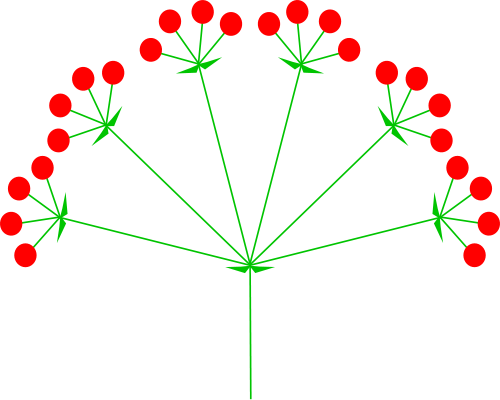
Let's get back to the umbel now that you know more about where I am going with this. The umbel may seem like it is just one big, dome-shaped flower.  Go ahead, bend down, check it out, it won't bite. That umbel is a compound flower that is made up of hundreds of branched florets. It is those tiny flowers that make up what you are looking at.  

(Trip into my brain: Did anyone see the Sensation exhibit from the Saatchi Collection at the Brooklyn Museum of Art back in '00? When I first walked into the space, to my immediate right, there hung a huge portrait of British child murderer, Myra Hindley.  Marcus Harvey painted Myra's maniacal monochrome visage from her arrest photo using children's hand prints dipped in black and white paint. Anyway, that reminds me of an umbel. Think about it.)

Welcome back.  So those miniature flowers are the BEST food for the BEST kind of insects you want in your garden.  Teeny parasitoid wasps and other beneficials feed off the nectar that is profusely produced from the umbel flowers.  

It is these wasps and flies that will go out an attack the aphids, cabbage loopers, tomato hornworms,  and all the other nasties that invade our garden spaces.  Have I stressed enough the importance of planting lots of umbel flowers within your vegetable gardens and perennial borders? This is called attracting beneficial insects, a very savvy gardening philosophy.  This is the first step in my personal integrated pest management protocol: I get to know my adversaries, and I staunchly promote their enemies.  Or, you can just think of it as "plant it and they will come".

Another benefit of this particular umbel is a benevolent one.  This quiet garden visitor means no harm, does no damage, and is truly thrilling to behold in all its stages of life.

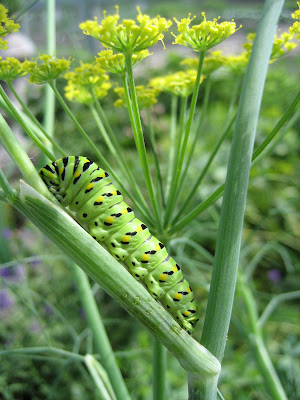
The larvae of the black swallowtail butterfly also loves the taste of fennel.  In early August I found 4!, yes 4! of these stunning larvae on one plant!


 I got a little macro-happy . . .

So I can only wonder where these glow worms are now. 

Have their wings dried? Are they sipping the late-season nectar of Eupatorium purpureum and Aster divaricatus?  I am just pleased to have observed them preparing themselves for their reincarnation.


Wednesday, September 17, 2008

Sissinghurst : The world's synonym for 'English garden'


Designed in 1930 by poet/author Vida Sackville-West and her husband, Sir Harold Nicolson, this progressive couple supported each other in the creation of their home and landscape. In addition to rebuilding the ruined rooms of their castle, Vida guided the building of outdoor rooms that still surround the main residence and the famous tower that served as her study. It is truly the gardens of Sissinghurst that survive the impassioned lives of Vida and Sir Harold, and puts on display the kind of bond that only happens between gardeners.

It was about 10 a.m. at Great Dixter.  I was working in the Sunk Garden deadheading tulips when Aaron whisked me away to visit Sissinghurst with Sarah, Fergus' assistant.  It really is so convenient that Vida and Harry chose a ruin just down the street from the Llyods.  Aaron navigated the crazy country roads to Sissinghurst like the pro he is. There were busses, full parking lots, and all sorts of proper folk gravitating toward this hexagonal tower. Certain death? Wacky Kool-aid? No, thanks. Maybe some other time.

Aaron, who by nature and nurture is not easily impressed, gave me the speediest tour of any garden I have ever been on, well, save for MS on Mount Desert Island . . . but I digress. Basically, he's seen the gardens 174 times and wanted to show us the features of the garden that were most important to see. There was no lolling about or pining over plants. As a result, I have a succinct understanding of the garden as a whole.  

The Reader's Digest version of Sissinghurst is this:  the Lime Walk, the Fall garden, the Hazel coppice, the Azalea and Wall garden, the White Garden, the hedging, the hedging, the hedging, the tower courtyard, and the biggest, fattest, Rosmarinus officinalis growing happily in the ground at the foot of Vida's tower. And! Ceanothus!, And! . . . Now I understand why Aaron sped through -- this could take all day, and we might miss tea. 

The Lime Walk is located to the far right of the gardens, so while it is a destination when it looks fantastic, it is not a focused featured throughout the season.  

The Lime walk had seen it.  It is primarily a spring garden profuse with bulbs. No wonder why they hid it behind a Taxus hedge to hide the wreckage. Smart. My initial reaction was, "Why isn't it cleaned up, planted, etc, etc." But, Hello! This garden is huge, and I know all about setting garden priorities when time and labor is at a premium. I had to ask, what is the deal with Limes? They aren't hardy, and it certainly was not the tree I was questioning. The answer was Tilia platyphyllos. Its flowers have a delicious fragrance similar to -- we're all smart people here -- lime blossoms! Even though my timing was off, I could just imagine walking through this lovely allée viewing whatever fabulous geophyitic display through the open windows of the tree trunks, woven together with the thick sweetness of lime blossoms.  

The Fall room looked great in mid-spring.

The wallflowers boasted about themselves in voices of reds, oranges, and yellows. Such saturated colors were a welcome respite to the Easter-egg gag reflex I usually experience with the spring color palette. I'm out to change all that.

(Pssst! So you see that chunk of chartreuse on the upper right?  Oh, my god. The most amazing, luscious stand of Euphobia characias I have NEVER seen before. I wanted to stand there all day, screw the tea.  Sadly, not hardy in my zone 5b-6, but who says? Just so the world knows, the Euphorbiaceae is my FAVORITE plant family.)

The Hazel coppice was a very pretty part of the garden. Not enough to be pretty, it also had a function. Coppicing is an ancient practice that was very widespread especially in that part of England. Each year, branches were cut down for firewood, fencing, etc. As a response, the tree/shrub sends up long shoots from latent buds. Talk about sustainability: each year a new and reliable source of fuel and raw materials was available. En route to the garden, we actually drove right through old coppiced woods with the clubby wounds as proof of the repeated cuts. 

Peering through the coppice, a statuary is sentinel. What struck me as sheer brilliance are the shadowed and glowing ferns all framed under the canopy of Corylus. Sir Harry designed this part, and how stellar the result. Garden design 101 here: repetition propels the eye forward. Now, 101 does not mean elementary; it means fundamental.

The azaleas were just on fire! Why does spring have to be a washed out introduction to a lively new season? No. After the bleak ick of winter neutrals, I want some eye candy!

Huge specimens of orange and yellow azaleas proved that this flamboyant couple were nothing if not inspired.

The wall was interesting; little hunks of mortar had been removed to accommodate plants that seemed to clutch you into them. Think Labyrinth circa David Bowie (aaahh).

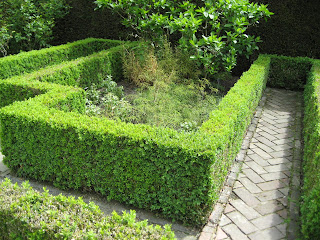
Sissinghurst is famous for its White Garden.  While I was not impressed with the early season show of white-flowered and silver-leaved perennials, I did fall in love with the structural elements of the layout. The meticulously trained and trimmed boxwood followed a slim serpentine pattern. The yew hedge behind it created planting areas in the bulges of the design. Who am I, but if I had a garden styled similarly, I would keep one type of plant growing in each enclosure. Cold? Maybe. Bold? Definitely. Thats the beauty of seeing other gardens and taking them one step further for yourself.  You can't argue with inspiration.

Don't try to tell me you can't see the humor in this.  Well, I suppose the incredible geometry should stand out more.

The strict hedging gave the garden a kind of precision. It felt official, stately, and well, proper. The lines were just so clean that it was the perfect visual element to balance the romanticism felt throughout the garden. 

In this garden, I imagine the dark corridors commence at dull heartache past openings of hope, to a destination at the warmth and light of a new love. 

In her own words, her garden is "profusion within the confines of uttermost linear severity". Well,  Vida was a poet.


Tuesday, September 16, 2008

Seed pods, unite!


Now is the time . . . all those dried out remnants of summer love are stuck like beheaded cannibals atop the varying heights of flower stalks.  You could just look at them, but what fun is that?  Snap 'em off, do a little reading, and figure out how to save, start, and grow them on for next year!

It never ceases to amaze me how ONE, just one, flower will make enough seeds to litter your garden like a ticker tape parade after the Yankees win the World Series.  Considering their winning streak, ahem, I'm just glad that life has rhythms that do not depend on major league baseball.

Those gorgeous pods are from Baptisia australisa fantastic US native.  Even if you don't care to grow on the seeds that are ripening now, cut them and use them in fall floral arrangements, or for other decorations for the season.

If you really are serious about collecting seeds, its very simple. You'll just need some envelopes, a pen, and something to cut the seed head off (sometimes you try to break it off and, well, you know Murphy's Law).

Label your envelope with the name of the plant (duh), the date, and where it was collected. Then go ahead and harvest those seeds! Do not be selfish; leave some seeds for others, as well as for that precious plant that worked so hard attracting pollinators in order to procreate itself. Next, seal the envelope and put in the fridge until you know what you are doing with them.

Don't forget to marvel at the unique shapes, textures, and scents of those seeds.  Have fun!

Tuesday, July 8, 2008

Let go of your INHIBITIONS . . .

This photo represents a thousand words of a fascinating story. A story of Inhibitions, Ultimate Patience, The Right Moment, and Grand Scheme.  
(Where are we?? Some kind of hedonistic S&M plant dungeon?) 

No.  No leather, no whips.  We are talking hormones and chemicals.
(Okay, now its getting REALLY weird)

Aaan-ti-ci-paaaaay-shun.  
Carly Simon had it right, but she didn't know she was singin' a tune about botany.

Let me drag you out of the dark recesses of my brain and back into the light. The photo that heads this post was taken in front of my home. Last spring I dragged home a HUGE Platanus occidentalis American sycamore branch that had been cut down from one of the properties that I work on.  I thought, Hey, let me lean this up against my chimney as a vertical element and grow some cool vines on it. The bark is just so incredible, especially againt the tall white chimney.
The previous fall, I planted the darkest lily known to man, Lilium 'Landini' as a contrast against the white, white chimney.  So  late last spring, at the base of the branch, I threw in some pre-soaked sweet pea seeds.  They grew, but didn't really deliver.  So even later,  I pushed into the soil the pink and black mottled skins of the scarlet runner bean, a giveaway from my friend Carlo Balistrieri. Alas, nothing. 

UNTIL!  The Great Awakening!  
(Remember all that jazz about Inhibitions, Ultimate Patience, Right Moments, and Grand Schemes?? Here is where it may make a bit more sense . . . )

What have I noticed, just now, snaking its way up the sycamore branch? Those loooong forgotten scarlet runner beans that I sowed LAST year! Mysterious. Odd. Why now?
  
Inhibitions, or more scientifically, inhibitors.  Plants have the most uncanny way of sensing The Right Moment. While waiting for the right light, temperature, and moisture level a seed can exercise Ultimate Patience. Be it a week, to sufficiently imbibe enough moisture from the surrounding media to trigger seed germination, or a year, until the soil temperature is cool enough for a particular seed to open up, that seed will waaaaaaaaaaaaiiiiiiiiiiiiiiittttttttt.   It is all a part of the Grand Scheme of things that guides the sublime tempo that nature keeps.

Many of us know the story of how the giant sequoia trees release the seeds from their cones. The cones "wait" months, years, whatever it takes, until a forest fire rips through the area.  The heat will then trigger the cone to open its scales and the seed is then dispersed.  The forest fire, and subsequent dispersal of the sequoia seed, is an essential part of maintaining healthy and growing forest ecosystems in the Pacific northwest.  Without the fire, no new sequoia seeds. Grand Scheme intact and perfectly functioning.

Even the diminutive sweet pea has an inhibitor that I attempted to break.  I mentioned before that I "pre-soaked" those seeds.  That was to speed up the germination process (many, many seeds benefit from this treatment).  That seed will not begin to grow until it is sufficiently swelled with water.

Now, the mystery of the scarlet runner bean (Nancy Drew #147).  Another germination inhibitor is soil temperature.  My contention is that when I pushed those seeds into the ground last summer, the soil was simply too warm to initiate germination! But since those seeds were not removed, spent winter outside, and warmed with the early spring soil, that Right Moment occured that woke up the little life that slept inside.   

Deviant references aside, that is just mind-blowing.  
                                                                                                              Really.