Thursday, April 9, 2009

NYBG Orchid Show: a modern makeover


It started with Dale Chihuly's glittering glass sculptures in the Enid A. Haupt glasshouse. This past summer, Henry Moore's heavy metal punctuated turf and framed views. This winter, it was Burle Marx, Brazilian landscape modernist designer, who brought the latest wave of haute art to the epicenter of haute horticulture.


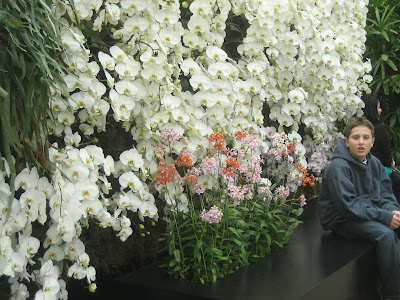
My best friend, Janelle Garguilo, a compelling graphic and interior designer, had the brilliant plan of going to the Bronx Zoo with my mother and my nephew.  Me? I invited myself.  But today was a wintry slap in the face: it was just too cold to watch the lions freezing on the cement savannah.  Instead, we detoured across the rugged safari of Southern Boulevard to the Enid A. Haupt conservatory for a warmer stroll through the last week of the NYBG Orchid Show: Brazilian Modern

As a lover of art, I find it so progressive that the New York Botanical Garden, that dusty New York institution, has taken these "risks" to allure visitors with a quality blend of plants and art. It only makes sense, and I wish they had done it sooner. 

The marriage of art and horticulture has a long history.  To really know a garden is to look at it as you would any expression of art. Truth be told, so many horticulturists and landscape designers I've met were previously trained as artists, and that experience is integral to their successful designs: Lynden Miller as a painter, and Jeff Mendoza as a sculptor, just to name some of NYC's contemporary finest. 

As the last reserve of orchids are removed and restrung, a few highlights before this experience fades:

How's this for a hanging basket?  Wow! 
I really love seeing horticulture pushed to an extreme like this!  The monotone Phalenopsis dangle just as they should, and the bright green pitchers of the Nepenthes that are tucked in add some serious interest. And what about that unknown aroid spreading it's HUGE leaves like it would below the canopy of a tropical rainforest? I'm woozy.  
This gives the container-planting philopsophy of "thrillers, fillers, and spillers" whole new perspective!

My nephew, Nick, . . .
 . . . was pretty impressed by the wall of pure white Phalenopsis.
I have to admit, so was I.  The is something to be said about seeing plants en masse -- it is candy that only your eyes can devour and taste.

I am always inspired by the color combinations that Fran and Marc mastermind.  Again, true artistry must exist for a successful planting display. My eyes always zero in on the subtleties of the tones and ranges of colors that are combined. 
Don't think you need a degree to put together a great combo. All you need is a personal aesthetic that will guide your visceral responses as you create a floral or textural vignette. Play time! To start playing with great color combos, all you need is to observe the palette and pull those colors out.  

Look here: the inflorescences of the bromeliad in the lower right are long gone, but the bright green ovaries and the orange stems and pedicels are a natural nod to the Pollock-splashes on the leaves of the Croton (a member of the Euphorbiaceae, my favorite!). It just feels right!
People may live in flats, but flowers? 
When I saw these plant apartments, I thought, hmmm, with eyebrow raised.  
Didn't love it, but liked it. Definitely a different way of adding height, using undervalued vertical space, and simply causing surprise.

Leave it to me to be shocked and moved by anything other than an orchid at an orchid show:
Look at this color! I practically warmed by hands by it!  As fire-red as your imagination can allow, I was so in love with the origami lobster claw cascade. This is one hot Tillandsia!
The clean lines, sharp architecture, and Art Deco repetition of Tillandsia dyeriana is just my style. It just might be my newest obsession.  Although, bromeliads have always been high up on my list.

So, parabéns, NYBG!  Another successful blend of art and plants.  Who's next? I dare you to give me Gaudi!

Wednesday, April 8, 2009

Winter blue is now spring green!

I think I am in denial.

Is it really spring?  

It took Herculean survival skills for this gardener to get through our Northeast winter.  I just might be over it for good; I say it every year: I want warmer weather for longer, I don't want my car to engage me in a snowy striptease every time I need to go someplace, and I definitely could do with out the tundra.  

But all that winter weariness wanders away as soon as my body and mind connect with the evolution of spring.  Regardless of the freak warm weather we get these days, I love the moments of disbelief that, there I stand, raking spring garden beds, in a t-shirt!  Feeling that warm sun on my skin makes me drunk and sleepy on it's vitamins; I lay on the grass hoping to feel it grow. What else can make me feel that kind of great?  I challenge you to tell me.  (I'm really glad I'm not a rabbit, or this kind of elation might manifest very differently.) 

Duncan Brine, fellow Pawlingian (read: those from Pawling) and mastermind behind his concept 'Garden Large' (check the Open Days, and GO!), wisely quotes on his webpage, 
"Every time I talk to a savant I feel quite sure that happiness is no longer a possibility. Yet when I talk with my gardener, I'm convinced of the opposite."
 -Bertrand Russel, philosopher, mathematician, and author (1872-1970)

What a time!  Spring!  The heightened awareness I have during this time is uncanny. Witnessing the progressive resurrection of those I tenderly laid to rest makes my heart swell and my head just a little dizzy with love.  

Doesn't everyone feel this way? 

(Hmmm . . . ) 

Well, then shouldn't everyone feel this way?

Wednesday, March 25, 2009

Compost: the second coming

People may argue why our present day is called Anno Domini (Did He come, did you miss it? Is He coming, do you look busy?). Whatever calendar you hang, you can't argue that it is spring and it really has arrived.  So for me, that means compost--not Christ.

Compost saves! 
Save garden cuttings, weeds, grass clippings, autumn leaves, veg and fruit peelings and other appropriate kitchen scraps ('forbidden fruit' is allowed), and compost will happen. Compost will save you from buying costly soil amendments that won't do the job as effectively.  Making compost saves all the natural resources from a garden and recycles them right back to the very plants that produced them. Pretty tight, huh?

Compost is coming!
Many methods abound for creating compost. Hot vs. cold piles, C:N ratios and the science of layering your "greens" and "browns". Do you pile or do you bin? Do you turn or do you spin? It shouldn't be overwhelming, but it definitely can be. Just remember that whatever method fits your time, energy, and compost needs, if you do it, it will come.

No compost, no peace--know compost know peace!
Compost is the great unifier. Compost comprises so many positive elements that together create a one-pot meal satisfying many a garden hunger. From building better soil structure, balancing pH, and increasing soil-moisture to inoculating soil with vital bacteria, fungi, and beneficial nematodes, compost redeems all previous garden sins. 

As an educator, I encourage gardeners to familiarize themselves with the organisms that make compost (and great soil) what it is. Reading Teaming with Microbes: A Gardener's Guide to the Soil Food Web by Jeff Lowenfels is a great start for any gardener curious about what happens beneath their feet. Billions of beneficial fungi and bacteria break down organic matter above and below the soil level. Increasing these populations in the soil has tremendously positive effects. These beneficial organisms "guard" roots, fight pathogens, release plant-available nutrients, and can help extend a plant's root zone increasing the ability of said plant to retrieve water and nutrients up to 3 meters away! There is so much more to it, of course.  The specifics are fascinating, and the soil food web is really a phenomenal underworld.

We all have one: a favorite meal, drink, or snack, that is just sooooo tasty, you ingest in disbelief that it is so good for you. Mine is carrot-beet-orange-apple-celery-ginger juice straight from my juicer. Yum. That is just what compost is to your garden: guilt-free goodness for the garden's soul. 

So to get your soil out of garden hell, spread a 1/4-1/2" layer of compost on your beds in early spring. A smart plan is to get in on the ground before bulbs are really going.  Personally, I prefer to compost the gardens when the soil is warming up and those winterized organisms are now awake and ready to work. It's a great idea to gently scratch, or as Fergus says 'tickle' it into the garden soil to incorporate it. If you know you'll be planting spring annuals you'll be turning enough soil then. Some people prefer to get the composting done in the fall if they have the time. There is merit to this practice as well: decomposition will continue to take place until the deep freeze sets in. Through the winter and spring the soil will freeze and heave, and together with seasonal snow and rain, the compost will work it's way into the soil where its got to be. 

Whatever works, I say, just as long as it gets done.   

Saturday, March 14, 2009

Sympathy is for suckers.


I am pissed.  And the last thing I want is a pat on the back or a pathetic, compassionate gaze.

I need to vent, and on top of it all, you are not even my captive audience. You've got that convenient little 'X' above this window to escape my rant.  But as for me, this is my life.

My roses are DEAD. Rosa 'Night Owl' and  R. Long Tall Sally'  are laying on my walk as still as the corpses they are.

Uuuuggh!

So this is what happened.  After searching for my misplaced pruners, I started in on getting my climbers in shape. They are really the only roses I bother with. They are up and out of my way, and do double duty in covering up a wall, a fence, whatever. I love pruning these roses: I love the way the canes will look after I've finished, like the tail of a Stegosaurus with spiky side shoots.

So, *snip* there goes a brown branch back to that essential outward facing bud.  But it looked all wrong.  It was brown inside where it should have been green, especially just above a decent-looking bud. Hmmmm. So I get in a little closer and notice that the whole plant is wobbling at the soil level.

"What the F---?!"

The WHOLE THING comes right out of the ground and THIS is what the "root system" looked like, gnaw marks included:


Can you BELIEVE that?  Ooh, I am so angry.  

So then I go over to 'Long Tall Sally' and give her a wiggle. Out she comes. Again with the profanity. 


Instantly I know. Bloody bastard vermin. See, last year we had a mouse issue. But that was fine because all they wanted to do was hang out in the laundry room, shit on our clean towels, and drag dryer lint around. But we smartened up, crushed a couple skulls, and Keith (being dramatic) left one or two of them in the traps as a "warning" to others. Sweet, ain't he? During the spring, summer, and fall, I guess they had time to plot their revenge. So they thought it might be all mousey-cute to sharpen their teeth on my rose roots? What kind of vindictive rodents ARE they? 


I just hate this. Not the mice, not the lost roses, but this:  for years, I would be the back patter and give the compassionate eye contact in response to garden annihilation. People who work slavishly only to have their results ruined by rabbits, woodchucks, deer, etc.  See, I didn't have any of that. I lived in a shiny garden bubble. But now?  I am one of YOU.  

Now, to reminisce after the loss . . . 

R. 'Long Tall Sally' was a share from my friend and former classmate, Peggy of Westchester Environmental Tree Service who gave me this rose when we were back in school at the NYBG. I nearly killed it, resuscitated it, then planted it safely in my garden. Tall as its name suggests, its canes climbed high, and its flowers were a very pretty pale peachy pinky yellow.
 
The 'Night Owl' was a cultivar I was SUPER excited about.  I even had a really funky clematis planted in anticipation for the color combo.  This is a very fragrant and deep dark plum-wine colored rose with shocking yellow stamens--ooh, I am getting delirious thinking about it.  Also a climber, this one promised to re-bloom and re-bloom, if only those BLEEP/noun BLEEPING/verb  BLEEPers/noun (Mad Libs, anyone?) didn't play God with my garden.  Maybe God was playing with me? I'll throw one back His way that's even better: your R. 'Night Owl' looks like the color of R. 'Dr. Huey', the crutch of all grafted roses! Ha! Wouldn't want that mistake in MY garden.  Oh, listen to me. I'm not bitter.

So enough. It's over, it's done. I hate mice, rats, voles, whatever resists my will to do garden-goodness. Lesson for this gardener: I will never look with pity upon anyone with a garden story of rodent victimization.  It's too painful to experience it, forget being patronized. 

Instead of the insufficient back pat, maybe I should just hand out mousetraps to lighten the mood.

Friday, March 13, 2009

Tony Avent: the Howard Stern of horticulture?


This past week I had the absolute pleasure of meeting Tony Avent, founder of Plant Delights Nursery in Raleigh, North Carolina. Tony is a renowned and dedicated plantsman who, like many of us plant geeks, is fueled and fascinated by the odd, the dangerous, the bizarre, and the gorgeous. Relentless and unapologetic in the garden, Tony waves his hand at hardiness zones, adventurously daring to plant, and grow, the unthinkable. With 18,000 plants and counting in his collection, Tony's botanic garden in Raleigh is the 4th largest in the nation, and is neighbored by some of the best gardens in the country: JC Raulston Arboretum, Duke Gardens, and the UNC garden at Chapel Hill. Tony's sweet tea timbre only enhances the enthusiasm he has for the plants he loves. And his humor? Who hasn't seen the provocative and hysterical covers of his famous mail-order catalogs? Well, for those of you who haven't, take a look at the latest:


Oh, and there's more!!! Instead of wasting time on YouTube and Facebook, scroll through the hate mail that Tony receives regarding his catalog, and that he unashamedly shares. Now that's a guy with character. 

So how did this happen? My friend Darrin Duling organized two lectures at the Garden Education Center of Greenwich, CT where this event was graciously hosted. We heard Tony advocate his most notable plants suited for Connecticut gardens on Tuesday evening, and vicariously journeyed with him on his plant explorations on Wednesday, where Tony explained the process of how plants go from the wild into your hands.

Oh it sounds just lovely doesn't it? Let me break the still water with this:


We horticulturists are dirty, there's no other way to say it. We gladly live in a world dominated by loose and promiscuous pollen, where flowers seduce insects making them drunk on their juices, and where plants engage in acts of bondage then slowly swallow their partners, where ovaries swell with the seed of another, and . . . 

Anaïs Nin or Nature?  Maybe a little of both. Either way, Tony Avent is one of us. Just as Howard Stern is a pundit on pornography, Tony turns up the heat describing new plants and hybrids in such a way that plant sex has never sounded so good, so natural, so right.

I think after spending a few hours with Tony, the crisply coiffed chatelaine's of Connecticut have been deflowered of the gentility of gardening.  While they may never admit that they furtively look at plants online, or that they might keep a few catalogs in their nightstand drawer, the facade has been breached!

What could be better than hearing Tony burst about 'late night rendezvous under the cover of darkness', and the morning-after shock of a night of 'wild plant sex'? If you're into hardcore plant sex as much as I am, you'll know that Baptisia 'Purple Smoke' was soooo worth it (and she's disease-free)!  

It wasn't all hanky-panky, though.  Tony brought to light some poignant perspectives on plants, gardening, and the world as we know it.

Let's begin at the end. Tony let out a few great closing remarks that I thought were important to share:

"If you are not killing plants, you are not growing as a gardener."- Tony, quoting  J.C. Raulston. Tony says he won't give up on growing a plant unless he has killed it at least three times. The lesson here is don't be discouraged by your garden failures. The epiphanies learned in a garden cannot be taught in a book.  So go, kill your plants; find out what works to keep them alive and thriving. 

"Plants don't always grow best where they are found in the wild". This next example is a bit of a shocker. Sarracenia sp./pitcher plant. Typically pigeon-holed as a "bog" plant, Tony has somehow realized that they flourish in his mixed borders, even under his peach trees. WHAT? Yeah. Peach trees. Basically, just because a plant is found growing happily in a ditch (or a bog), doesn't mean that it won't reward you for moving it and providing it with a few different variables. Don't think (I don't commonly suggest this): just DO. Throw the plant tag away, and experiment! If you lose the plant, refer to the above quote.

"You do not learn duplicating what you already know." Priceless. This is permission to be creative, try the absurd, challenge the book-logic, and GROW: as a gardener, as a person, as a creative force. For further clarification, refer to the above two quotes.

"Gardens are about anticipation." This I relate to 100%. Every day now I go outside and silently beg my Crocus 'Jeanne d'Arc' to hurry up. Classical music calls them 'movements', and the garden equivalent is something I call 'moments'. A garden is a relentless crescendo of moments that is planned and planted for in anticipation of the unfolding drama in the season to come.

A theme through both lectures was plant origin. Whether a natural hybrid, a selection from an intensive breeding program, a chance seedling, or a cutting from a foreign plant, the question that Tony invariably knows the answer to is: who's your Daddy? Origin in terms of "how did this this plant get into my car", Tony uncovered some interesting criteria a plant must meet to survive in the nursery industry. 

Overall, I was privileged to listen to Tony's adventures, and to be introduced to some of his favorite plants. I was fascinated by his extensive knowledge of breeding and plant parentage, and his experience in this industry that spans many, many years. 

Please visit the Plant Delights Nursery page to read up on Tony's many plant collecting excursions, and articles.  Also, while you're there, sign up for the email updates. Oh! And of course, lose yourself in the pages, pictures, and descriptions of the odd, the bizarre, the dangerous, and the gorgeous.

Darrin, thanks so much for giving me the head's up about Tony coming into town. And to Tony, I genuinely look forward to seeing your garden soon.

Monday, February 23, 2009

Heale House: welcome for the winter-weary


Before I arrived in England, Sarah told me that we would visit a little-known garden gem on our way to Dixter: Heale House.

"Of course," I said.  I am always up for anything, especially when a (now) local is suggesting it.

After passing the sublime megaliths of Stonehenge, morosely cordoned off by the macadam of the A344 and the A303, we drove on to Heale House.  Located off one of the many quaint and charming roads of Wiltshire, only a little sign indicated we'd arrived.

Heale House has been around for a while: due to some major military blunder in 1651, King Charles II crept clandestinely across the countryside in an effort to escape to France.  He arrived at Heale House, and while hoping to evade recognition, the lady of the House distinguished who he was and made arrangements for his protected stay.  Not too shabby of a hideout.

In early spring now, there are millions, no BILLIONS of little stowaways haunting the grounds of Heale House.  Small and forgotten until they demand your attention, the season of snowdrops and winter aconite bring them all out in full and glowing spectacle.

Galanthus. Commonly known as snowdrops, the lovelies of this genus are the very earliest of spring geophytes to brave their will against a reluctant winter. Cheery hope, these little flowers are.  Forget the groundhog: if I was hibernating for months, I would want to poke my head up and take a look around as well. His shadow is neither prophesy nor gospel; it's nature.  Get over it, PA. Although, through some stroke of coincidence, there is a correlation between America's Groundhog's Day  and Candlemas day, both celebrated on February 2nd. An old folk name for Galanthus is Candlemas bells, signifying the peak of the bloom season. (I am still eye-rolling the groundhog.)
Now THAT is telltale spring. Call me a plant snob; I am more willing to accept Galanthus as a harbinger of spring, however long the season actually takes to arrive.

Others like me, well, more obsessed than me, take Galanthus very seriously. Within the 19 species that represent the genus, there are innumerable natural hybrids and named cultivars. The real challenge is telling them apart or tracing parentage.  Regardless, each species, hybrid and cultivar are exceedingly charming in their own ways, even though they may all look just like pretty and dainty white flowers. Maybe that's all we really need to know.  Here are two varieties that stuck out to Sarah to and me:
Galanthus 'Dionysus' 


The second little beauty of the late winter landscape is Eranthis hyemalis winter aconite.  A minor bulb with a discerning fashion sense, its cup of sunshine is collared by a very distinctive ring of green bracts.

Now just imagine standing in this pool of light . . . I asked Sarah how long it would take to establish a self-sown population like this.  Apparently, Eranthis take many years to flower from seed, so I could only imagine how many years this stand has been slowly increasing in size.

It certainly was my pleasure to see it now, however long ago the first bulbs were sunk into the soil.  It was  so charming to see the drifts of white and yellow intermingling along the paths and hilsides . . .

Besides this spring display, there were many more features about this garden that had no other choice than to stand out. 

These raspberry-veined Hellebrous stopped us both in our tracks.  There are so many color variations in the new hybrids, but sometimes, just one will be enough to make you look twice. The fact that the open flower is somewhat upwardly angled is also a bonus.


The river Avon has been divided into 3 channels coursing through this property.


Oh, what a parade of the Victorian age to have a peacock loitering on the stoop.  By the way, those are not sheets that blew off the line; those are used to protect tender plants from any damaging environmental conditions of late winter/early spring.

As we made our way out, I literally drew in a deep breath  as I saw this Cedrus libani/Lebanon cedar. How majestic is this tree?  Pruned to keep this shape, its umbrella canopy swallows that VW Rabbit.  Then again, from firsthand experience, anything is bigger than a VW Rabbit.  I do love those Euro headlamps!


A perennial garden designed by on of England's well-known designers, a charming (everything in England is so charming; it's kind of annoying!) vegetable, fruit, and herb garden, and an authentic Japanese tea house also grace this estate.

Thanks, Sarah, for taking me to Heale House to see that amazing display of minor bulbs. It was a perfect start to what may have been the longest (definitely memorable) day of my life!

Wednesday, February 18, 2009

Pruning: the slowest of the performing arts?


It is early spring, and despite the damp and the chill that characterizes an English winter, I have returned to Great Dixter. 

It was mid-spring when I first arrived last May. Blue skies were the backdrop to the thrill of my experiencing Dixter for the first time. Here I am now in early spring where the skies, a bit cloudier, suspend the damp air within my expanding curls. I haven't had one good hair day since I've arrived!


This visit differs in a very meaningful way. First of all, I got to see my friend, and astute plantswoman, Sarah Carter Roberts. Former Curator of Herbaceous Plants and Outdoor Gardens at the NYBG, she is now living it up in Tidworth, England with her new hubby Giles. Every week she travels to many of the outstanding RHS gardens within her radius to study and learn what makes English gardens tick. She collected me from the airport (the term 'red eye' doesn't do it justice), and we made many lovely detours on our way to Dixter. After a giddy evening, we enjoyed the luxury of working together in the garden the next day.

With what time I have at Dixter during this visit, I too, am taking in all that I can.  What I am appreciating now is seeing how the garden is setting itself up to unfold for the upcoming season. All throughout the garden beds can be seen the very first layers of bulbs clustered above latent perennials. 

Without the perennials and self-sown volunteers disguising their backbone, visibly outstanding are the evergreen plants and shrubs that hold the garden erect.  

The real reason I am here is not to muse about the early signs of spring (big perk, though). I am here to learn more about restricting that explosion of new season growth through thoughtful pruning. There is a graceful art to achieving a vigorous, healthy, and well-shaped plant despite its age or character, and this art deserves consideration. As I instinctively knew, and am discovering here, there is so much more to pruning than what the books say.

At its very basic, the practice of pruning involves removing any DDD (dead, diseased, dying) and crossing branches, or following the thumb rule that declares that no more than 1/3 of the plant is to be removed each year (about the latter: "Rubbish," Fergus says). If you are happy with the basics, great.  But if you desire to work a little deeper than what the basics will yield you, the reward for your efforts will be a fine specimen tree, shrub, or vine.

The pruning of woody shrubs is a fascinating endeavor. I will never admit who told me that "horticulture is the slowest of the performing arts", but it has always stuck, and thoughtful pruning is the poster child for that truth. So as you gaze at your shrub, sharpened Felco's or loppers in hand, ask yourself: WHY am I pruning? WHAT am I hoping to accomplish?

(A word on goals: Unless we are talking about boxwood, "Meatball-ing" is an unacceptable pruning goal. We've all seen it, and some of us might even be guilty.  Amnesty is available, though, even to people like my father who would annually bring my mother to hysterics because he insisted on "pruning" the Forsythia.)  

Rejuvenation, increased flower or fruit production, specific training (pollarding, espalier, hedging), reduction of size, encourage ornamental foliage . . . these are all specific goals that, when pruned with that goal in mind, your plant will respond to. Before cutting branches without intention, really LOOK at what you are about to do, and before you cut, ask this: What will happen next? And in the season after that? Even 10 years down the road? Every pruning cut illicits a growth response from the plant that you can anticipate, learn to envision, and plan for. Cause and effect matters here. Is that dead horse beaten enough? PETA may agree. 

Here are the basic principles that I took home as my souvenirs:
  
1.) Fergus was careful to guide my first cuts (this is Great Dixter, not my backyard) by asking me to remove the most obvious and benign material first. This consisted of removing any and all spent flowering stems either completely, or cut back to a new strong shoot. STOP, and look.
 
2.) Next, remove any dead, weak, or insignificant twiggy junk that is growing off of the  stems and larger branches.  This "opens up" the negative space so that you can now more clearly see the inner structure of the stems and branches. STOP, and look.

2a.) You will notice lots of thick old wood, weak and spindly growth, and you will see strong new growth. It is that vigorous new growth that will keep your plant young, that will flower best, and will produce the growth that will contribute to the following year's framework. You may be tempted to cut all the wild new growth down in favor of the older structure that is already there. I've done it, let me admit it! But that is for the short-sighted, which I am no more.  

3.) Identify all the weaker wood, branch by branch, and cut remove that weak wood to the most vigorous shoot. Clean up the stem or branch of any weak wood/stems to ensure that all the plant's energy goes into the desired growth.  This part takes the most time and thought for me. The goal is balance: not just in the actual perception of the shape, but also, a balance of old and new wood.  You can easily remove too much new wood sacrificing flowers and/or fruit. 

About rejuvenation: Keeping the old growth encourages an old and weak shrub. When old growth is judiciously removed according to your rejuvenation plan and vital growth is encouraged, that plant will literally be a fountain of youth. Check this out: just guess how old this Weigela is?

I was astonished (and a little scared, as this was one of my pruning assignments) that it is the oldest shrub in the Long Border, and is at least 60 years old. It has form, it has shape, it has vitality. Fergus keeps these enduring gems in a constant state of rejuvenation--the only way to sustain the valued pieces of this garden's history. 

The difference below may be subtle, but this Weigela is on the 10-year plan.  It will flower well this year, there is a lot of vigorous growth, and the non-productive has been removed. 

Same principles apply to this Viburnum.  The difference is the age and character of this shrub.

After all the flowered,  twiggy, and non-productive wood is removed, a much more open an healthy shrub is achieved.  

What about general maintenance? Let's say you have a vine, such as the Lonicera below, and you want to make sure that it flowers as best as it can. How do you even go about unravelling this puzzle?  It can be overwhelming if you are not clear on WHY and HOW.

Thankfully, the same principles apply: take out all the spent flowering stems (muddies up the form), little twiggy junk (sucks energy away from flowering), and view what is strong and best (new growth with lots of flowering buds).  In the case of this honeysuckle, the growth that is strongest, is also longest.

You can see how much material was actually removed by comparing the two photos. Fergus then loosely tied up the outward-reaching stems to the post using tar twine. This keeps the stems trained, and when in bloom a graceful and arching effect is achieved.

I suppose for me, a few key lessons where learned that have successfully changed the way I think about pruning:

1. Have a plan, and know for what objective you are pruning.

2. Do not be scared.  It will--hopefully--grow back. 

3. You control the plant, the plant does not control you.  This is the essence of ANY gardening, for gardens as we know them would not exist without that crucial human element.

4. Think ahead.  Any pruning cut will have a consequence (desired or not) that will be seen next year, and in following years.

5. Know whether the shrub or vine you are pruning blooms on OLD or NEW wood. 

6. Work slowly--smallest to largest, from the inside out, and in some cases from the bottom up.

7. Really, work slowly.  Resist the urge to get in there and yank out the branch that looks like its "in the way".

8. Do not fight the character of the shrub.  If it is twiggy, it will always be twiggy. 

9. Feeding goes hand-in-hand with pruning.  Ring the base of the newly prunes with a generous amount of compost.

10. Make sure you ladder is secure.

Early spring is the best time to prune plants that bloom on old wood (last year's growth). To all the meatballers of the world--STOP! Once your nausea subsides, sharpen your pruners, and untangle yourself a renewed, vigorous, and well-shaped plant!